


Articles and guides
Practical advice, ingredients and stories about solid cosmetics.
In-depth guides
Choose a topic and find practical answers.





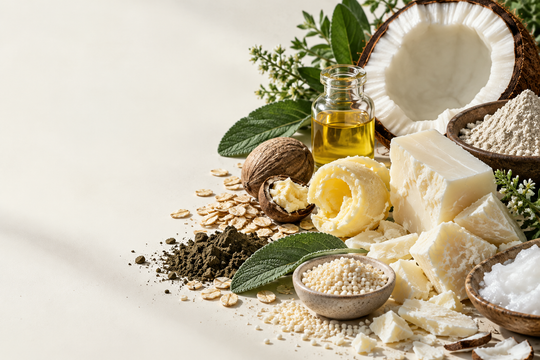
Ingredient Atlas
Ingredient origins, textures and practical answers about cosmetic labels.
Read the guide

Solid Cosmetics School
Practical lessons for using, storing and travelling with solid cosmetics.
Read the guide
Which One? Comparison Studio
Clear comparisons for the cosmetics you use, the routines you enjoy and the gifts you give.
Read the guide

Gift & Gifting Encyclopedia
300 articles about thoughtful gifts: people, occasions, traditions, beautiful presentation and words that feel like you.
Read the guide
Body Cleansing Explained
Does your skin feel tight after the towel? Are you choosing a bar, or wondering where to put it when it’s wet? Start with the part of the shower you’d like to make easier.
Read the guideArticles: 1444

Ingredient Atlas
Polyglyceryl-4 laurate
Creaminess does not always begin with a butter. An emulsifier such as polyglyceryl-4 laurate helps bring oily and watery ingredients into one texture, and can be supplied as a syrup-like...

Ingredient Atlas
Petrolatum · the jelly made from liquid and solid
Petroleum jelly has a familiar feel, but its structure holds a lovely material surprise. It contains both liquid and solid hydrocarbon portions arranged into a stable, spreadable lipogel. Petrolatum is...

Ingredient Atlas
Polyglyceryl-2 triisostearate
A lipstick needs more than a beautiful pigment. The colour has to be distributed through a mixture that glides, stays coherent and feels right on the lips. Polyglyceryl-2 triisostearate belongs...

Ingredient Atlas
Paraffin · the wax framework of a compact
The edge of a perfume solid is a small piece of material engineering. It has to hold a useful shape, yet the surface must still yield enough for a swipe....

Ingredient Atlas
Polyglycerin-3
Glycerin has a larger relative that changes the feel of a formula without becoming an oil. Polyglycerin-3 links familiar building blocks into a different material, bringing moisture retention and sensory...

Ingredient Atlas
Hydrogenated Ethylhexyl Olivate · olive beyond the oil bottle
An olive-derived emollient can have a name that sounds nothing like a kitchen ingredient. Hydrogenated Ethylhexyl Olivate is one example: an ester material used for softness and a chosen sensory...

Ingredient Atlas
PEG-120 methyl glucose dioleate
A cleanser's texture can be surprisingly independent of how much it cleans. This long-named ingredient helps explain the difference. Built around a glucose connection and oily components, it is used...

Ingredient Atlas
Hydrogenated Olive Oil Decyl Esters · an olive-derived soft wax
Olive oil can lead to a wax-like material as well as a flowing oil. Hydrogenated Olive Oil Decyl Esters are one example, with a current commercial grade designed for soft,...

Ingredient Atlas
Lecithin
The same seed can supply an oil and a very different material that helps oil meet water. Lecithin belongs to that second story. It is a mixture rich in phospholipids,...

Ingredient Atlas
Octyldodecanol
Not every fatty alcohol arrives as a waxy flake. Octyldodecanol is a liquid, with a branched structure that opens a different texture story. It can help a compact solid carry...

Ingredient Atlas
Myristyl myristate
The repeated name is a useful clue. Myristyl myristate joins a myristyl alcohol part to a myristic-acid part, creating a wax-like ester that can bring body and a substantial emollient...

Ingredient Atlas
Acacia senegal gum
A tree can supply an ingredient without giving up a seed or a leaf. Acacia gum begins as an exudate from stems and branches, drying into glassy-looking pieces. Prepared for...




